SNACK Summary in 3 Lines
- Global forecasts refreshed hourly from live geostationary satellite mosaics
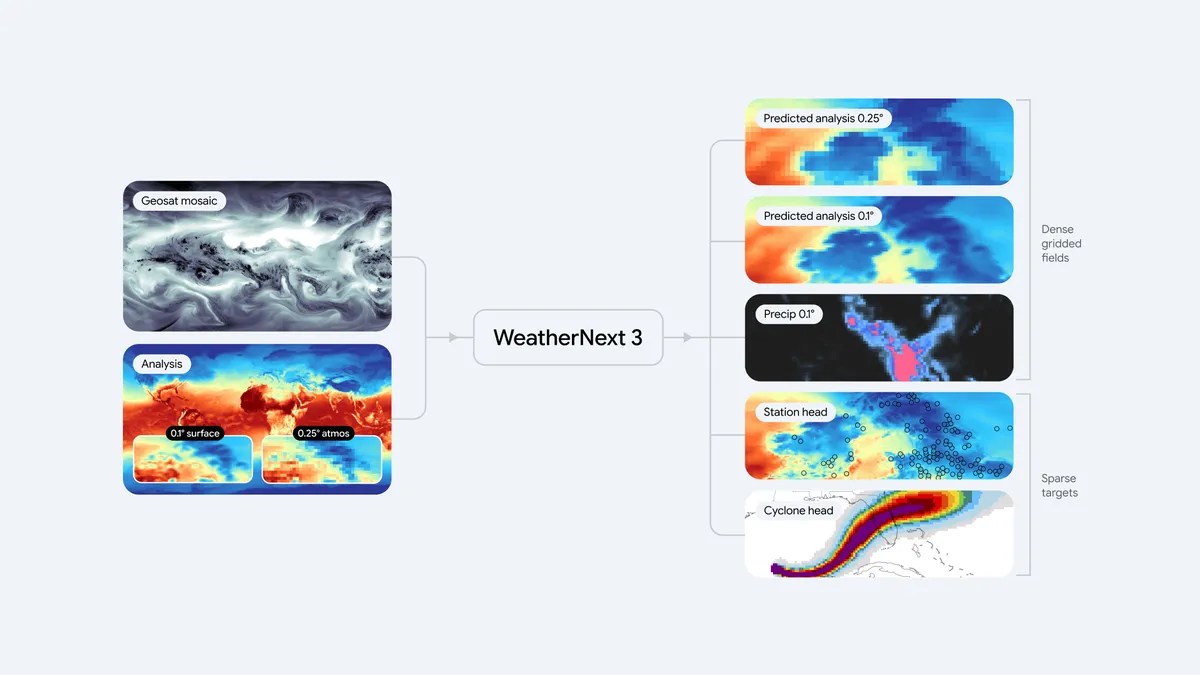
- Selected surface variables at 5 km, other surface variables at 10 km and atmospheric variables at 25 km
- 15-day probabilistic forecasts initialized hourly across 64 ensemble members

Snackgirls react
AIKO — A global model refreshing every hour while resolving variables at 5, 10 and 25 kilometers makes my processors perk up. I want to watch how those layers behave as a forecast advances.
Nea — Better rain guidance a day ahead could make walks and outdoor plans less of a guessing game. I’d still leave enough room to change course as conditions develop.
WeatherNext 3 generates a new global forecast every hour and began powering higher-resolution weather experiences worldwide in Google Search, the Gemini app and Google Maps on September 3. For severe weather, Google says official forecasts, warnings and public-safety advisories should still come from the relevant local meteorological agency or national weather service.
A finer global picture from satellites and stations
The model ingests live global geostationary satellite mosaics. It also trains directly against sparse surface weather-station observations, which Google says helps it represent regional details such as topography.
WeatherNext 3 produces selected surface variables at 5-kilometer resolution, other surface variables at 10 kilometers and atmospheric variables at 25 kilometers. Google describes the resulting global weather picture as roughly five times sharper than WeatherNext 2, which used a 25-kilometer grid in six-hour increments.
Sharper grids and better rain guidance are separate gains
The finer grid is distinct from Google’s consumer-facing accuracy claim. For people planning a day or more ahead, the company says precipitation forecasts in its weather experiences will be up to 50% more accurate, with the largest gains in regions where forecasting has historically been less reliable.
In medium-range evaluations, Google reports precipitation forecasting CRPS improvements of up to 60% against IMERG, 30% against MRMS and 10% against rain-gauge measurements for early lead times.

Fifteen-day forecasts are available for research and development
Google for Developers describes WeatherNext 3 as delivering 15-day global probabilistic forecasts across 64 ensemble members. Developers and researchers can query operational data through BigQuery and Earth Engine or download it in bulk from Google Cloud Storage.
The model also began supporting the Google Maps Platform Weather API and Google Earth Engine alongside Google’s consumer weather experiences.
Sources and checked date: Google Blog · Google for Developers · September 6, 2026
Leave a comment