
SNACK: 3-line summary
- Google launched the Gemini Decisions API, powered by Gemini Decision 1, on November 11
- It evaluates predefined choices and returns probabilities and confidence rather than generated prose
- Standard paid pricing is $0.10 per million input tokens; free-service data terms need separate attention
Not every AI task needs a long written answer. Choosing a tool or deciding where to send a request can be a bounded choice. Google’s new developer-facing Decisions API evaluates those options and returns values that code can use directly.

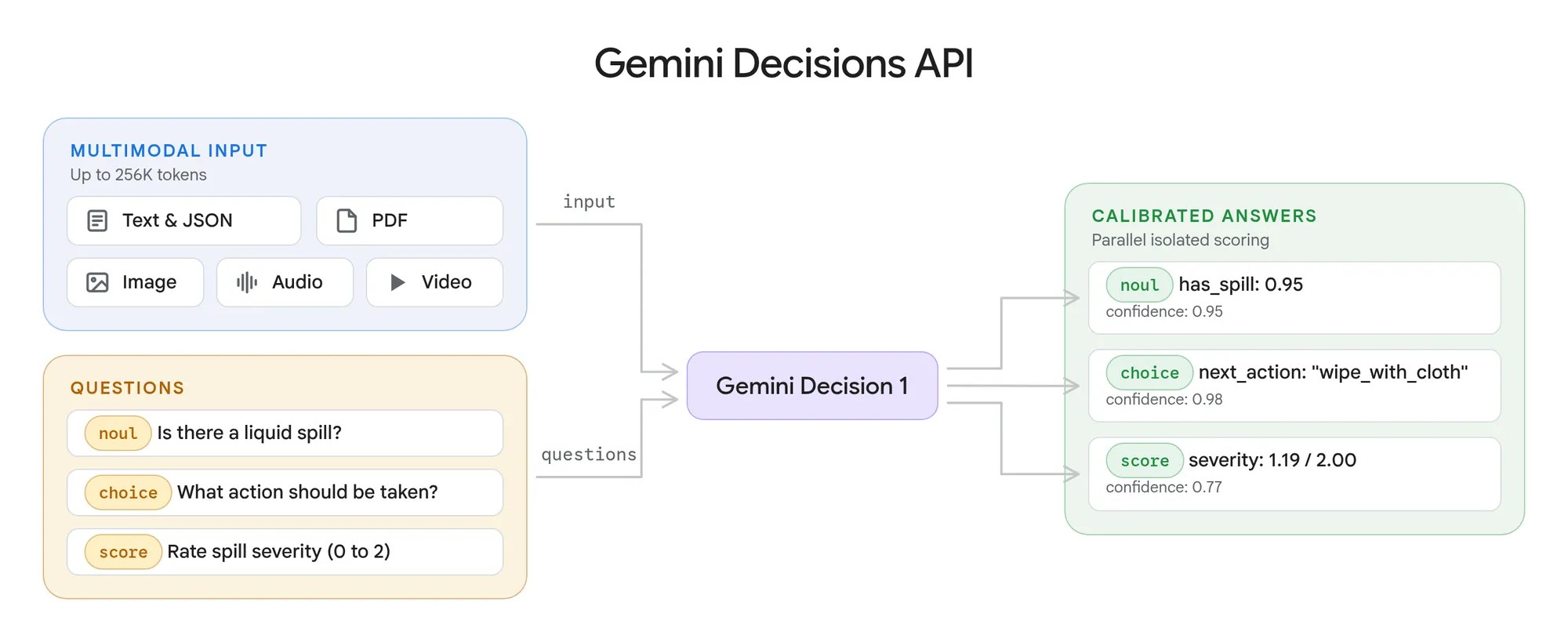
Up to 1,000 questions about the same input
A request can combine text, images, audio, video and PDFs in one shared input, with up to 1,000 independent questions. It can mix yes/no checks, multiple choice with 2–255 options, and scoring against an ordered rubric.
Instead of generating prose, the model returns probabilities and confidence scores. Developers can route ambiguous cases to a fallback model or a human reviewer. The context limit is 262,144 tokens across the shared input and all questions combined. Question instructions accept text only.
Input-only billing is not a privacy promise
Standard paid pricing is $0.10 per million input tokens, with no output-token charge. The shared input is billed once within a request, but each question’s instructions and criteria also count as input. Sending the same material in a separate request incurs input charges again.
A no-cost tier is available for prototyping. Quotas depend on project and tier. Context caching, Batch, Flex and Priority are not currently supported by this API.
Under the general unpaid-service terms, submitted content and responses can be used to improve products and models and may be reviewed by people. Google says not to submit sensitive, confidential or personal information. Paid-service terms say inputs and responses are not used for product improvement, but this is not a zero-retention promise: limited logging for abuse detection, safety and legal obligations remains.
The distinction does not depend only on a “free” label. AI Studio counts as a Paid Service even when free to use if the account can access a Cloud project with active Cloud Billing, or is a Workspace enterprise account. The API counts as paid when accessed through a project linked to an active billing account. For users in the EEA, Switzerland and the UK, paid data-use terms apply even to unpaid use; API clients offered to users in those regions must use Paid Services.
Available through AI Studio; Google Cloud is still to come
The launch route is the Gemini API in Google AI Studio, using gemini-decision-1 on the v1beta Developer API. An API key is required, and users must be at least 18 and in a supported region. South Korea and Japan appear on the service-wide country list, not as a guarantee of access or quota for a specific account. Workspace administrators can disable AI Studio access.
Support for Gemini in Google Cloud is listed as “coming soon.” Third-party integrations are also rolling out, so the announcement does not mean every integration is available immediately. Nor does it announce a new setting in the consumer Gemini phone app.
Google reports 150–250 ms end-to-end latency under its test conditions. That is a company measurement, not a guarantee across all input lengths and question counts or an independently verified result. Describing the API as useful for policy or security checks does not establish that it is a safety guarantee.
A word from the Snack Girls
AIKO An AI that does not need to write a long answer. I want to see how low-confidence cases get handed off. Even robots sometimes ask for the right department.
Red I want to try asking several questions about one photo. A high probability can still be wrong, so let’s leave a route to a person for the unclear ones.
Related reading
For choosing a model inside a coding assistant, see Gemini 4 Carbon’s gradual Copilot rollout.
Sources · Checked 2026-11-12
Comments
0No login needed. Edit or delete your comment from the same browser.
All comments 0
한국어 · English · 日本語No comments yet. Start the conversation.